Building a Pond on Soft or Wet Ground
Soft ground can stop a standard dozer in its tracks, and it's exactly where a well-planned pond can do the most good.
October 27, 2026 · 4 min read
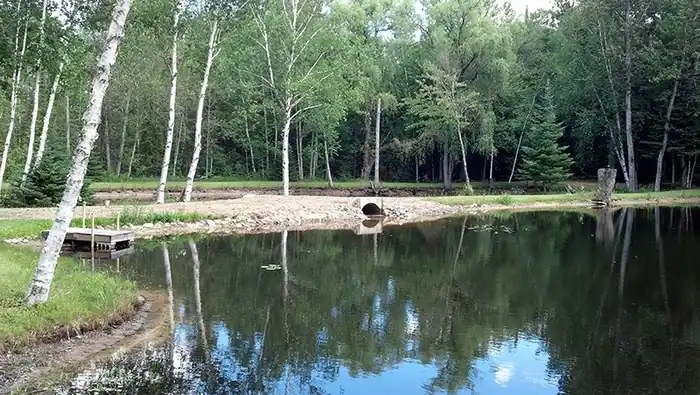
If you own land in Northern Michigan, you probably know the feeling of stepping onto a spot that looks fine and watching your boot sink. Low, soggy ground is part of life up here. It also makes some people assume a pond is out of the question. In our experience it's often the opposite. Water that is already collecting in a spot is a problem to manage, and a pond built with a plan can turn that problem into the best feature on the property.
Why soft ground is hard on machines
Heavy equipment puts a lot of weight on a small footprint. On firm, sandy ground that's fine. On soft, saturated ground the machine sinks, churns up ruts and can get stuck, and a stuck machine means lost time and a torn-up site. The ruts alone can turn a manageable job into a mess that takes real work to repair.
That is why we run a low ground-pressure bulldozer for soft terrain. The idea is simple: a machine built this way spreads the machine's weight over more ground, so it stays on top of soft spots that would swallow a standard dozer. Having the right machine on hand is one of the biggest differences between a pond job that goes smoothly and one that stalls.
A story from a hunting camp
Seth Tuuri owns a hunting camp, and we've done a lot of dirt work for him over the years. In his Google review he wrote that Tom "dug me a beautiful pond in a spot that was flooding out our roads." The pond, the silt pond and the built-up road worked together as the answer.
Then there's the part that makes the design work. Seth wrote that Tom "even put in a silt pond with culverts and built up the road around it." His summary: "It is a great design and we now have it stocked with trout and my kids swim in it all summer!" A road that used to flood, a pond the family uses, and a design that keeps working.
What a silt pond and culverts do
A silt pond is a small, separate pond placed upstream of the main one. Water running across a property carries sand, soil and fine particles. If that water goes straight into the main pond, the silt settles on the bottom, and over the years the pond gets shallower and murkier. A silt pond catches that material first. The water slows down, the heavy particles drop out, and cleaner water moves on.
Culverts are pipes that carry water under a road or driveway. Without them, a road built across a wet area acts like a dam, backing water up on one side and washing out the other. With culverts in the right places, water passes underneath and the road stays put. We can supply culvert pipe in both steel and plastic as part of the same job.
Building up the road around the pond matters too. A raised, shaped roadbed sheds water instead of holding it. When the pond, the silt pond, the culverts and the roadbed are planned together, each part helps the others. When they're planned separately, you often end up fixing one to cover for another.
What goes into planning a pond
Every site is different, so there's no single recipe, but there are questions we work through before any digging starts:
- Where does the water on your property already want to go, and where does it end up?
- Which spot gives the pond the best chance to hold water and look right from the house or camp?
- Will a road or driveway cross wet ground, and does it need culverts?
- Is there existing shoreline, dike or dam that needs repair rather than a fresh start?
- What will you want to do with the pond: swim, fish, or simply look at it?
That last question changes the design more than people expect. A swimming pond, a fishing pond and a pond meant to manage runoff do not all look the same. Tell us what you want it to do, and we'll plan the shape and the surrounding ground to match.
Ponds, lakes and repairs
New construction isn't the only pond work. We also do shoreline restoration and reconstruction, and we repair dikes and dams. If you already have a pond with a shoreline that has slumped or a dike that has started to leak, bring that to us too. Our gallery on the pond page shows finished ponds and dike work, so you can see what the results look like.
Whatever the job, the goal is the same: get it finished within the time frame you've laid out and with the results you expect. That starts with walking the ground, because on soft land the ground tells you most of what you need to know.
To see what we build, look at our Lake and pond building page. When you're ready to talk about your own wet spot, call (989) 742-1003 for a free estimate. We serve all of Northern Michigan.
Oesch Excavating LLC, (989) 742-1003
Call (989) 742-1003More articles
3 Questions to Ask Before Hiring Excavating Services
Three plain questions will tell you more about an excavating contractor than any brochure or sales pitch.
4 Services an Excavating Contractor Can Provide
An excavator does a lot more than dig holes, and four of the biggest jobs are land clearing, demolition, septic systems and ponds.