Clearing Logged Land for a Camp or Deer Plots
Logged land comes with stumps, holes and slash, and turning it into a camp or a set of deer plots is a matter of doing the steps in the right order.
October 27, 2026 · 4 min read
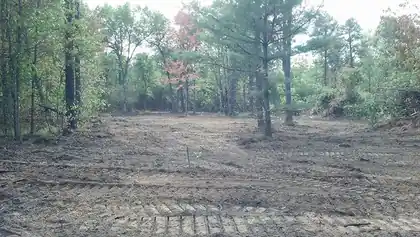
Logged land can look finished from the road, but it isn't. The trees are gone, but what is left behind is a field of stumps, tops, brush and uneven ground. If you bought it for a camp, a hunting spot or a place to build someday, the first job is making it usable. That takes machines, a plan and a crew that has done it before. Here is how we approach clearing logged land in Northern Michigan, and the story of one customer who did exactly this.
Jamie Cutler's 12 acres
Jamie Cutler owns 12 acres that were logged in 2018. In his Google review he wrote that the property "had stumps everywhere." He had us clear about 3/4 of an acre for camping and put in a nice road around the property. His summary of the job: "They removed the stumps and filled in the holes for me."
He described Tom as "Capable! Honest! Professional!" and added, "I could not be happier with the job he and his operator accomplished for me." The clearing for a camp site, the road and the stump work were all done by the same crew and the same machines, which kept the project in one piece.
Why you can't just leave the stumps
Stumps are more than an eyesore. They're hard on mowers and vehicles, they get in the way of anything you want to build or plant, and and as they rot the ground around them can sink and turn uneven. If you want a flat camp pad, a place to park, or open ground for a plot, they have to go.
Pulling a stump leaves a hole, and that is the step people forget about. An open hole is a place to turn an ankle or drop a wheel. It also fills with water, which keeps the ground soft. The fix is to fill and shape the ground so it is level and firm. That is the other half of what Jamie described: the stumps came out and the holes were filled in. Skipping the filling means you have traded one problem for another.
The order of work
Every property is a little different, but clearing logged land generally goes in a sequence. Doing the steps out of order costs time, so we plan it before the machines start:
- Walk the land and decide where the camp, the road and the open ground will go.
- Clear the brush, tops and leftover trees from the areas you'll use, and dispose of them rather than leaving piles.
- Remove the stumps and roots from the cleared area.
- Fill the holes and grade the ground so it drains and doesn't settle into dips.
- Build the road or driveway on a base that will hold up to traffic.
- Strip and set aside topsoil where it will be needed.
Each step sets up the next. A road built before the stumps are out will have to be torn up. Topsoil spread before the holes are filled will settle and leave dips. Getting the order right is cheaper than doing any one step twice.
Roads around the property
A road around a property does more than get you between the gate and the camp. It lets you reach every part of the land without driving across the cleared area, and it gives you a clear line for hauling firewood, bringing in materials or getting equipment to a trouble spot. We build gravel or hard-surface roads and driveways, and we supply the stone ourselves.
Wet ground changes the plan. If the road crosses a low area, culverts and a built-up roadbed keep water from sitting on it. Our galleries include wet land trenching for exactly those situations, and our low ground-pressure bulldozer lets us work soft ground without tearing it up.
Clearing for deer plots
Deer plots are part of our land clearing work, and our gallery includes a set of them. A plot needs open ground with the stumps out, the surface worked smooth, and access so you can get in with whatever you plan to use to plant and maintain it.
Where you put plots matters as much as how you clear them. Think about how you'll enter the land, where the wind and the sun hit, and how the plots sit relative to your camp and road. Talking that through during a site walk is part of what we do before we start. Seth Tuuri, who owns a hunting camp, said Tom has done a lot of dirt work for him there and is "always willing to do whatever I need or bring me materials."
What to expect from us
When we clear a lot we dispose of the trees and the rubbish, so you're left with usable ground and not piles to deal with. We can also handle tree trimming and removal, stump and root removal, and any site prep for foundations, roads or geothermal, so the project doesn't need three different companies.
If you have logged land and a plan for a camp, a road or a set of plots, our Land clearing and site prep page shows the kinds of work we do. Call us at (989) 742-1003 for a free estimate. We serve all of Northern Michigan.
Oesch Excavating LLC, (989) 742-1003
Call (989) 742-1003More articles
3 Questions to Ask Before Hiring Excavating Services
Three plain questions will tell you more about an excavating contractor than any brochure or sales pitch.
4 Services an Excavating Contractor Can Provide
An excavator does a lot more than dig holes, and four of the biggest jobs are land clearing, demolition, septic systems and ponds.